

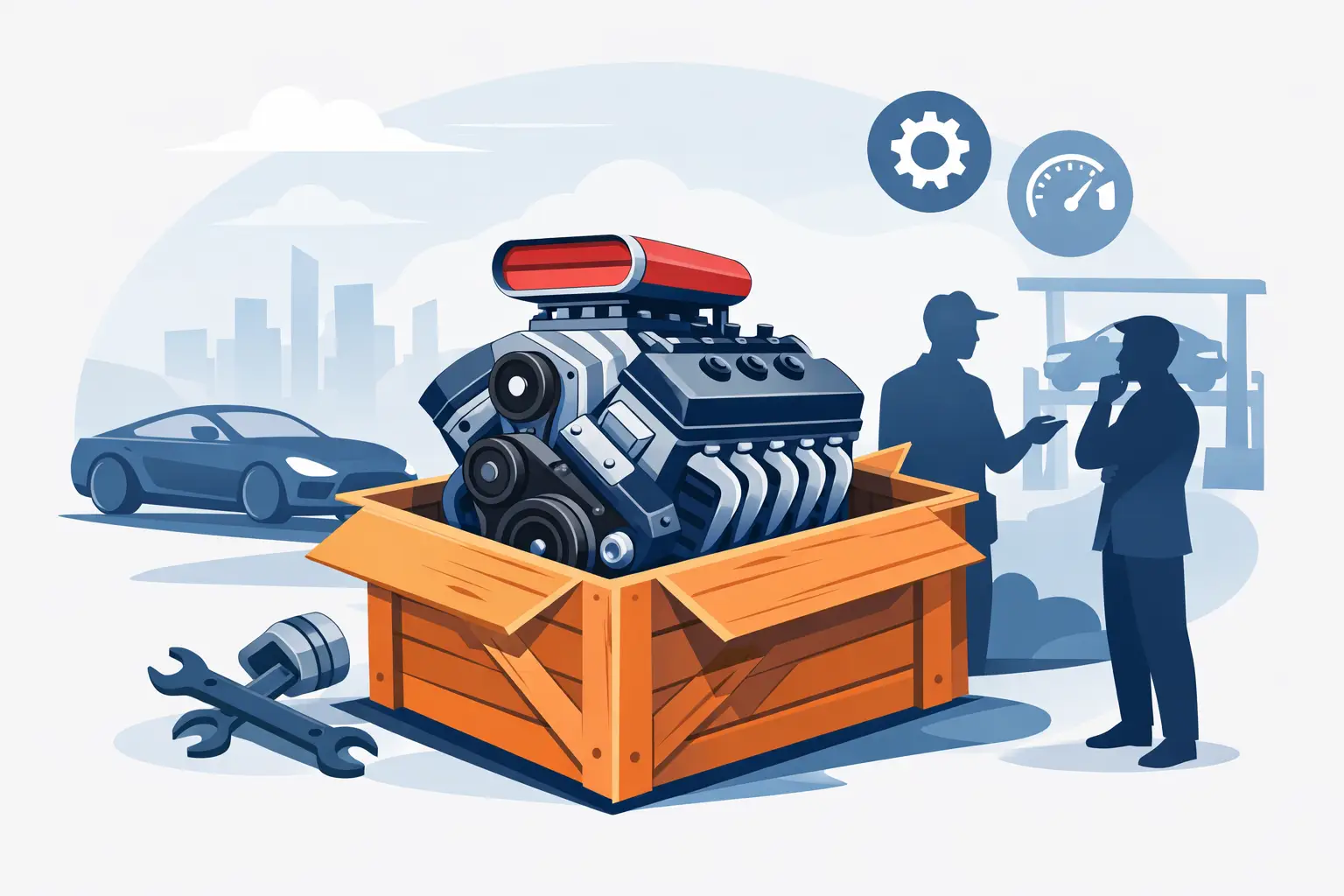
When a vehicle, vessel or machine is down because of engine failure, the real question is rarely theoretical. It is commercial. What is a crate engine, how complete is it, and will it get the asset back into service without the delays and uncertainty that come with a rebuild? For professional buyers, that is the point. A crate engine is a complete or near-complete replacement engine supplied as a factory-built or professionally assembled unit, packaged for transport and intended to simplify installation.
The term sounds straightforward, but in trade supply it covers more than one specification level. Some crate engines are long blocks. Some are dressed engines with ancillaries fitted. Some are turnkey packages ready to drop into a vehicle or piece of equipment with minimal transfer of components. The difference matters because purchase errors usually happen at the edges – wiring, fuel system compatibility, emissions equipment, control modules, mounting points and accessory fitment.
What is a crate engine in practical terms?
In practical buying terms, a crate engine is an engine sold as a self-contained replacement unit rather than as loose parts or a rebuild kit. It is typically shipped in a protective crate or export frame, which is where the name comes from. The value is not the crate itself. The value is that the engine arrives as a defined product with a known specification, known condition and a clear installation starting point.
For workshops, fleet operators and procurement teams, that changes the risk profile. A rebuild depends heavily on the condition of the core engine, machine shop quality, parts availability and the skill of the rebuilder. A crate engine shifts more of that uncertainty upstream. You are buying an assembled engine unit with a stated build standard instead of trying to rescue a failed assembly component by component.
That does not mean every crate engine is identical in scope. Some are supplied without intake, exhaust, turbocharger, injectors or electronics. Others include these items and arrive close to installation-ready. Serious buyers do not purchase on the label alone. They purchase against a full specification.
What a crate engine usually includes
A basic crate engine generally includes the cylinder block, crankshaft, pistons, connecting rods, camshaft and cylinder heads already assembled. In many cases, it will also include the timing components, oil pump, sump and rocker cover. At that stage, it may be described as a long block.
A more complete unit may also include fuel injectors, manifolds, turbocharger, water pump, flywheel housing, sensors and front-end accessories. This is where the term dressed engine comes into play. For some applications, especially commercial and marine, buyers prefer the most complete specification available because it reduces workshop labour, fitment delays and compatibility issues.
However, more complete is not always better if the installation requires the reuse of application-specific components. Engine management systems, emission control hardware, cooling layouts and mounting arrangements can differ by model year and market. That is why experienced buyers verify part numbers, serial ranges and accessory configuration before placing an order.
Crate engine vs rebuilt engine
This is the comparison most buyers care about because the decision affects downtime, labour cost and warranty exposure.
A rebuilt engine starts with an existing used engine. It is stripped, inspected, machined where needed and reassembled with replacement parts. If done properly, a rebuild can be a sound solution. It can also be the right answer when the original engine is rare, heavily application-specific or not economically available as a replacement unit.
A crate engine is different because it is supplied as a complete assembly built away from the vehicle or machine. That often means faster procurement, faster installation planning and less dependence on local machining capacity. For a busy workshop or commercial operator, that time advantage can outweigh a lower headline rebuild cost.
The trade-off is straightforward. A rebuild may offer lower initial spend if the core is salvageable and the workshop already has the right capability. A crate engine usually offers more certainty on assembly standard and faster turnaround, but only if the supplied specification matches the application correctly.
Why professional buyers choose crate engines
The main reason is downtime. If a van fleet, patrol boat, generator set or contractor machine is off the job, the cost is not limited to the engine invoice. There is lost revenue, delayed work and pressure on service schedules. A ready-to-install replacement unit helps compress that disruption.
The second reason is predictability. Buying a tested, specified engine assembly is cleaner than trying to estimate the real cost of reclaiming a damaged engine with unknown internal wear. Once strip-down begins, rebuild budgets often move. Cracked heads, worn bores, damaged crank journals and unavailable components can turn an apparently manageable repair into a longer and more expensive process.
The third reason is procurement control. Commercial buyers need equipment that can be quoted, approved, shipped and installed against a known scope. That is especially true in export markets, where delays around parts sourcing, customs documentation or fragmented supply can create avoidable cost. Suppliers focused on complete engine units rather than loose internal parts are usually better aligned with that requirement.
Where crate engines are used
In the automotive sector, crate engines are commonly used for replacement of failed petrol or diesel engines in cars, pickups, light commercial vehicles and performance applications. For workshops, they provide a direct route to getting customer vehicles back on the road without committing to a long rebuild cycle.
In marine work, the principle is similar but the specification discipline is tighter. Marine engines must match cooling systems, control arrangements, power output requirements and installation envelope. A crate-style replacement engine is useful for repowers and like-for-like replacement, but marine buyers need to confirm whether they are buying a base engine, a marinised package or a complete propulsion-ready unit.
In industrial and power equipment, crate engines are often used in generators, pumps, compressors and site machinery. Here the engine is one part of a wider system, so compatibility with governor settings, output ratings, mounting geometry and ancillary drives is critical. The best purchase is not simply the cheapest engine. It is the engine that fits the duty cycle and integrates without rework.
What to check before buying a crate engine
The first check is the exact application. Engine family alone is not enough. Buyers should confirm engine code, power rating, emissions standard, ECU compatibility, mounting points, sump configuration and accessory layout. A unit that is mechanically similar can still create installation problems if one of those details is wrong.
The second check is how complete the engine really is. Terms such as complete, turnkey and ready to install are useful only when backed by a parts list. Ask what is included and what must be transferred from the old engine. That includes injectors, turbo, starter, alternator, manifolds, wiring loom, sensors, flywheel, control modules and cooling components.
The third check is test status and supply condition. Professional buyers should know whether the engine is new, remanufactured or reconditioned, whether it has been bench tested, and what documentation accompanies it. For export and trade supply, packaging standard and shipping readiness also matter. A good engine specification can still become a poor purchase if transit protection is weak or paperwork is incomplete.
Is a crate engine the right choice every time?
No. There are cases where a rebuild remains the smarter route. If the engine is specialised, if original matching numbers matter, or if the existing unit has minor damage and local overhaul capacity is strong, rebuilding can still make commercial sense.
There are also cases where the better answer is not a crate engine but a complete power package. In marine propulsion, generator replacement and some industrial applications, buyers may need more than the engine core. They may need transmission compatibility, control systems, alternator integration or full auxiliary support. That is where a supplier with access to complete engine units and associated drivetrain equipment adds real value.
For many trade buyers, though, the appeal is simple. A crate engine reduces variables. It gives the workshop or engineering team a defined replacement path rather than an open-ended repair exercise. That is why the format remains popular across automotive, marine and industrial sectors.
If you are evaluating replacement options, treat the crate engine as a specification purchase, not just a product name. The closer the match between the supplied unit and the real operating requirement, the faster the installation and the lower the risk. For businesses managing uptime, that is usually where the decision is made.
