

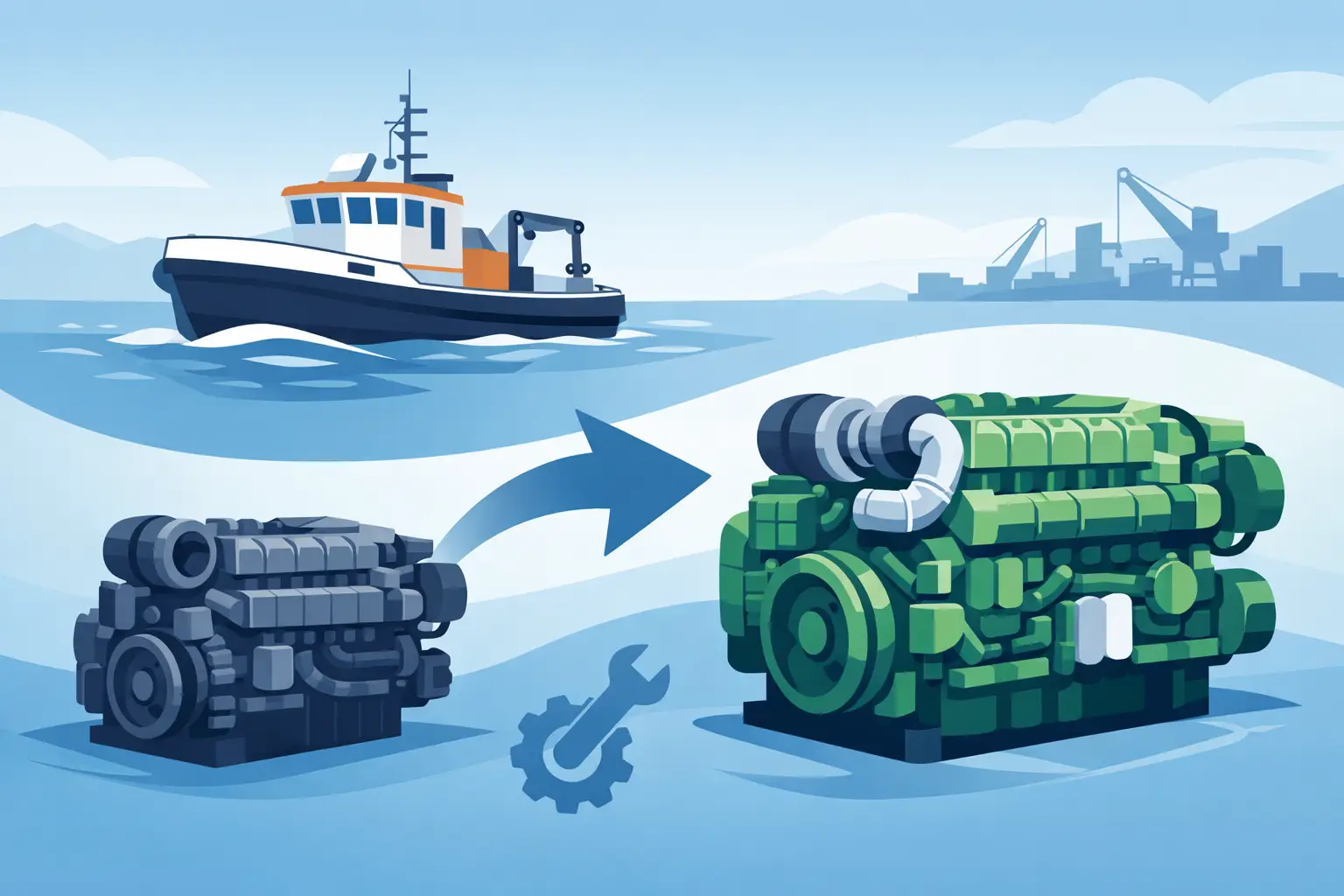
A workboat usually tells you when the current engine has stopped making commercial sense. Cold starts get longer, oil use climbs, parts lead times stretch, and fuel burn no longer matches the duty cycle you are paying for. If you are weighing up how to repower workboat diesel systems, the real question is not simply which engine fits the bay. It is which complete package gets the vessel back to work with the least disruption and the lowest whole-life risk.
For commercial operators, repowering is not a cosmetic upgrade. It is an uptime decision. A poor engine match can leave you with driveline issues, poor bollard pull, excess vibration, or an installation that takes far longer than planned. A correct match improves reliability, supports compliance, and gives engineering teams a cleaner path from removal to recommissioning.
When a diesel repower makes sense
There is no fixed hour mark at which every workboat should be repowered. Some engines remain economically viable for years with disciplined maintenance. Others become a liability earlier because the application is severe, the cooling system has had a hard life, or the engine model is now awkward to support in your region.
The strongest case for repowering usually comes from a combination of factors rather than one failure event. Repeated downtime, rising repair spend, uncertain parts supply, smoke under load, reduced power, and poor fuel economy all point in the same direction. For operators running patrol boats, harbour craft, crew transfer vessels, fishing boats or utility launches, lost operating days often cost more than the engine itself.
There is also a strategic reason to act before total failure. A planned repower lets you control specification, shipping, yard time and installation sequencing. An unplanned failure usually means paying for speed, accepting compromises, and putting commercial commitments at risk.
How to repower workboat diesel without creating new problems
The biggest mistake in a marine repower is to buy on horsepower alone. Rated power matters, but so do the power curve, torque delivery, operating rpm, gearbox compatibility, engine mount geometry, shaft speed, and the way the vessel actually works. A harbour workboat pushing at low speed has very different needs from a fast commercial launch.
Start with the vessel profile. You need accurate details on hull type, displacement, current propulsion arrangement, gearbox ratio, shaft diameter, propeller dimensions, exhaust layout, cooling system, and available engine room space. Then look at how the boat spends its time. Is it idling for long periods, running near full load, manoeuvring in tight quarters, or making regular transit legs at a fixed speed? Those details determine whether the replacement engine should prioritise low-end torque, continuous-duty durability, or lighter weight.
That is why complete engine units are generally the safer route for professional buyers. A tested, installation-ready package reduces compatibility questions and cuts the number of variables your workshop has to manage. For fleet operators and trade buyers, that matters more than chasing a theoretical saving on a loose engine plus separate components.
Match the engine to duty, not brochure figures
Marine diesel ratings can be misunderstood, especially when buyers compare engines across different brands and applications. Maximum output figures may look attractive, but continuous commercial use demands a more disciplined reading of the rating. An engine that performs well in light recreational service may not be the right answer for a workboat that spends long periods under sustained load.
Check the intended duty class carefully. Then compare the existing engine’s true operating load with the replacement unit’s output band. If the current installation was underpowered, simply replacing like-for-like may repeat the same problem. If the old engine was oversized and rarely worked efficiently, rightsizing can lower fuel use and improve service life.
Gearbox and driveline compatibility matter
A repower often succeeds or fails at the gearbox. If the new engine produces power at different rpm, the existing reduction ratio may no longer suit the propeller or shaft speed. In some cases the current transmission can be retained, but only after verifying torque capacity, bellhousing compatibility, drive plate specification and operational ratio.
This is where marine businesses and procurement teams benefit from sourcing support rather than treating the engine as an isolated item. The engine, gearbox and propulsion train must be assessed as one working system. If one component is out of step, the vessel may never perform properly.
The installation points that affect downtime
In practical terms, repowering a workboat is a packaging exercise as much as a mechanical one. Even when nominal engine dimensions are close, details such as mount spacing, service access, sump depth, turbo position and exhaust outlet location can change the amount of fabrication required.
Measure the engine room properly before you commit. Check lift-out route, hatch clearances and whether ancillary items need to be removed for installation. Look closely at fuel lines, wet exhaust runs, intake routing, electrical harness length, control interfaces and panel location. If the replacement engine introduces electronic controls where the old engine was fully mechanical, allow for that in both installation time and crew familiarisation.
Cooling arrangement is another common pinch point. Heat exchanger, keel cooling and raw water systems each impose different constraints. If the new diesel rejects more heat, existing pipework or cooling capacity may need upgrading. Ignore that and the boat may launch only to run hot under commercial load.
Compliance, documentation and export readiness
For commercial buyers, a workboat diesel repower is not only an engineering task. It is also a documentation exercise. Serial numbers, engine specifications, test status, and emissions or classification-related paperwork may all need to be recorded for flag, insurer, surveyor or customer requirements.
That is one reason buyers increasingly favour recognised brands supplied as certified, tested units. It simplifies procurement and reduces uncertainty at handover. If the engine is moving across borders, export packing, shipping documentation and clear commercial communication become just as important as the mechanical specification.
For operators sourcing internationally, the supply chain needs to be dependable. Delays at the point of shipment can disrupt yard bookings and labour schedules, which is why professional buyers tend to prioritise stock certainty and technical support over headline-only pricing.
Budgeting for the full repower, not just the engine
A realistic repower budget includes more than the engine invoice. Removal, lifting, mount changes, coupling work, exhaust adaptation, cooling modifications, controls, instrumentation, alignment, commissioning and sea trials all add cost. In some cases, replacing the engine but keeping old peripherals creates false economy, especially if those parts are already near the end of their service life.
There is no universal rule on what should be replaced at the same time, but flexible mounts, hoses, clamps, wiring sections, control cables and ageing exhaust components deserve close attention while access is available. A workboat out of service is already costing money. Returning it with known weak points still in place rarely pays off.
This is also where a complete, ready-to-install engine package can protect the budget. Fewer unknowns at the start usually mean fewer labour overruns during the yard period.
Choosing a supplier for a workboat diesel repower
Professional buyers do not need sales language. They need specification accuracy, recognised brands, tested equipment, and clear delivery terms. When assessing suppliers, look at whether they understand commercial marine duty, whether they can support gearbox and propulsion matching, and whether they offer complete units rather than leaving your team to assemble a package from scattered parts.
Availability matters. So does after-sales support. If your vessel works to fixed contracts, the difference between a supplier who can confirm stock, prepare export paperwork and respond quickly on technical points, and one who cannot, is operational rather than cosmetic.
For that reason, many fleet and trade buyers work with suppliers that focus on certified, export-ready engine units with support around shipping, sourcing and post-sale requirements. Businesses such as World Engine Traders are built around that model because professional procurement is rarely only about buying metal. It is about reducing downtime risk.
What a good repower looks like after launch
A successful repower is visible in daily operation. The engine starts cleanly, reaches rated load without strain, holds temperature, and works with the gearbox and propeller instead of against them. Fuel burn becomes predictable. Vibration is controlled. Service access is sensible. Most importantly, the boat returns to revenue work without recurring engineering surprises.
That outcome depends on making the right decisions before the old engine is lifted out. The specification must reflect the vessel’s real duty, not assumptions carried over from the previous installation. The package must be supportable where the boat operates. And the supplier must be able to deliver more than a crate and a promise.
If your current engine is already draining yard hours, repair budget and confidence, waiting rarely improves the numbers. A well-planned repower puts the vessel back where it belongs – earning.
