

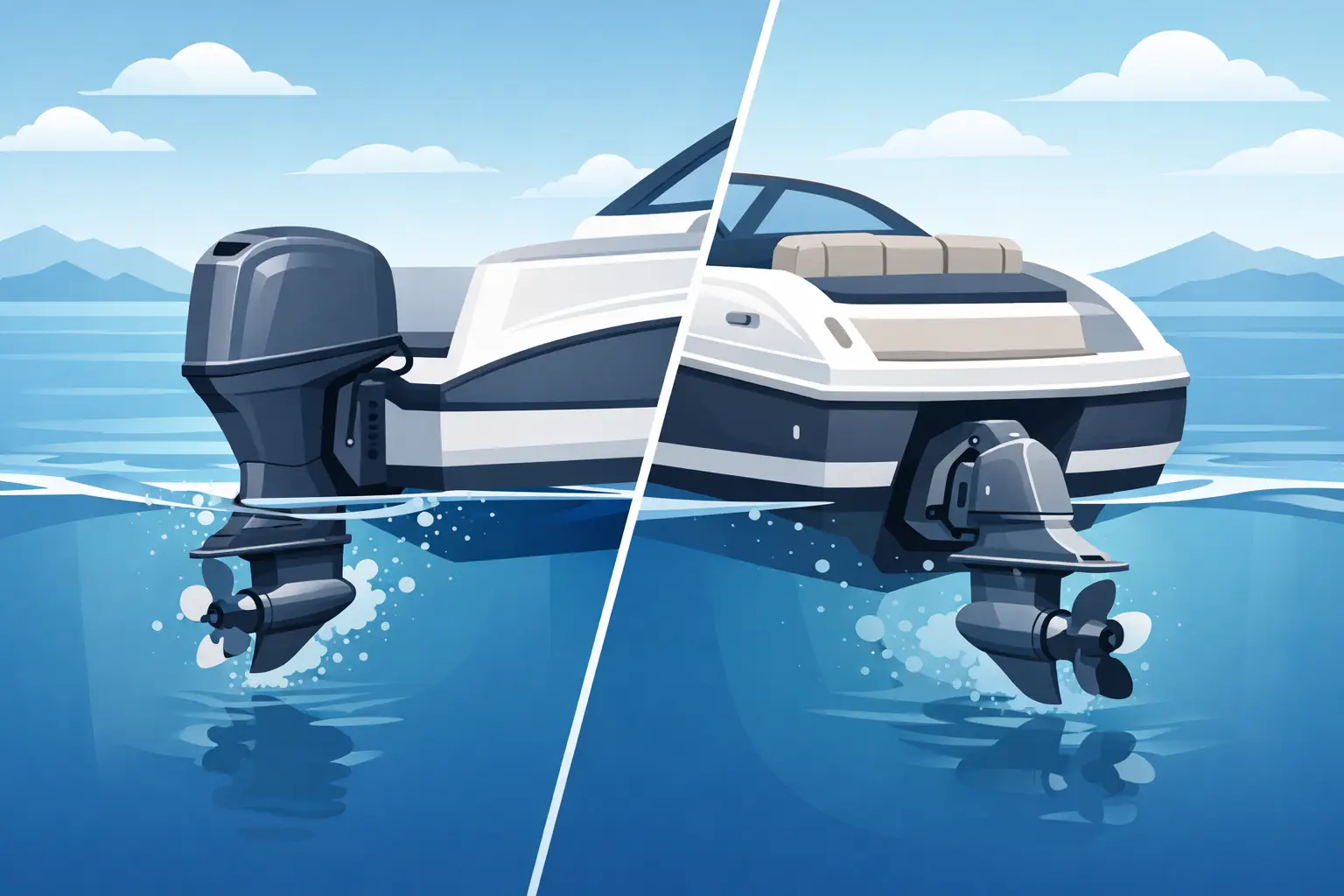
A repower decision usually looks simple until the vessel is on the hard, the old unit is out, and the real question lands on the desk: outboard motor vs sterndrive. For commercial operators, marina service businesses, boatbuilders and trade buyers, this is not a styling choice. It affects installation time, maintenance access, fuel burn, usable deck space, transom loading, stock planning and long-term operating cost.
The right answer depends on how the boat works, who services it, and how quickly downtime has to be recovered. A patrol craft, a charter RIB, a small workboat and a leisure cruiser can all arrive at different conclusions for sound technical reasons.
Outboard motor vs sterndrive – the real difference
At a mechanical level, an outboard is a self-contained propulsion unit mounted externally on the transom. Engine, gearbox and lower unit are integrated in one package. A sterndrive, by contrast, combines an inboard engine inside the hull with a drive leg mounted through the transom.
That distinction matters because it changes almost everything around the engine. With an outboard, installation is generally cleaner and replacement is faster. With a sterndrive, weight sits further forward, the boat keeps a clear transom profile in some layouts, and certain hulls benefit from the packaging and balance.
For buyers responsible for vessel uptime, the bigger point is this: outboards simplify replacement logistics, while sterndrives can make sense where the boat was designed around an inboard installation and where torque, hull attitude or onboard layout favour that format.
Service access and downtime
If a boat earns money, serviceability is never a side issue. It is often the deciding factor.
Outboards are usually easier to replace as complete units. If a major failure occurs, the engine can be removed and swapped with less disruption to the vessel structure. That is valuable for operators who need quick turnaround, especially in export markets or remote locations where workshop time is expensive and berth availability is limited.
Routine servicing is also straightforward in many cases because key components are accessible without working deep inside an engine bay. For fleets and service workshops, that can reduce labour hours and speed up scheduled maintenance.
Sterndrives involve more components distributed between the engine compartment and the drive assembly. Access can be tighter, and major repairs may require more labour. Bellows, gimbal bearings, universal joints and transom assemblies add service points that must not be ignored. None of this makes a sterndrive a poor option, but it does mean maintenance discipline matters more, especially in saltwater use.
For professional buyers, the implication is direct: if your operation values quick unit replacement and predictable servicing, outboards often have the advantage. If your workshop already supports inboard systems and the vessel platform is built around that architecture, a sterndrive can still be commercially sound.
Performance on the water
This is where assumptions can get expensive. Buyers often treat performance as a simple speed question. It is not.
Outboards deliver strong top-end performance on many hulls, particularly centre consoles, RIBs and lighter planing craft. Modern units offer impressive power-to-weight ratios, clean rigging options and responsive trim control. Multi-engine configurations also allow redundancy, which is a serious advantage for offshore commercial and support applications.
Sterndrives, however, can offer very good mid-range efficiency and solid power delivery in boats that benefit from a lower centre of gravity and inboard-mounted engine mass. On certain cruisers, sports boats and heavier leisure platforms, that weight distribution can improve ride and handling.
Acceleration, top speed and fuel economy are all hull-dependent. A boat designed around twin outboards will not necessarily perform better with a sterndrive conversion, and the reverse is equally true. The propulsion system has to match the hull geometry, displacement, intended load and duty cycle.
For trade buyers sourcing complete propulsion packages, the safest approach is to assess the vessel as a whole system rather than compare horsepower figures in isolation.
Fuel use and operating cost
Fuel efficiency is one of the first questions procurement teams ask, and rightly so. Over a season, small differences become material.
Modern outboards have improved significantly in fuel economy, especially four-stroke models from established brands. They are efficient, widely supported and well suited to operators who want current emissions standards and predictable running costs in a compact package.
Sterndrives can also be efficient, particularly where diesel inboard configurations are involved and where the vessel runs long hours at steady cruise speeds. In commercial settings, that can shift the cost equation. A diesel sterndrive setup may offer lower fuel cost per hour in some applications, even if installation and maintenance are more involved.
That said, headline fuel economy should never be separated from service cost. If a propulsion system saves fuel but spends more time off the water or requires more specialist labour, the total cost advantage can disappear quickly.
A useful buying test is to calculate operating cost across fuel, routine service, expected wear items, seasonal lay-up requirements and the likely cost of major component replacement. That gives a more accurate commercial picture than fuel burn alone.
Space, layout and vessel design
The outboard motor vs sterndrive decision often comes down to the boat itself.
Outboards free up internal hull space because the engine sits outside the boat. That can create more room for storage, equipment, passenger use or deck access. For workboats and commercial passenger craft, that extra usable space can matter more than a marginal performance difference.
Sterndrives place the engine inside the hull, which consumes internal volume but can suit boats designed around engine box layouts, aft seating arrangements or swim platform access. In some leisure and mixed-use formats, that remains an attractive setup.
Weight distribution is also central. Outboards place more mass at the transom. On some hulls this is perfectly acceptable, and on others it can affect trim, static balance and ride quality. Sterndrives move part of that mass forward, which may better suit the original naval architecture.
This is why repower projects need proper specification review. Swapping propulsion type without checking structural load, transom strength, ventilation, cooling requirements and overall balance is a shortcut to poor results.
Saltwater use and corrosion exposure
Marine equipment lives or fails by maintenance standards, but the operating environment still shifts the risk profile.
Outboards are exposed externally, which makes rinsing, inspection and replacement easier. Many operators prefer this in saltwater fleets because visual checks are simpler and the unit can be tilted clear when required.
Sterndrives operate with critical assemblies passing through the transom and submerged drive components exposed to corrosion, fouling and galvanic issues if protection is poor. They can perform reliably for years, but only when anodes, bellows, seals and corrosion control are managed properly.
For high-use coastal operations, buyers often favour propulsion systems that simplify inspection and reduce the number of hidden service risks. That is one reason outboards are widely chosen for patrol, charter and support boats.
Which buyers usually prefer each system?
Outboards are often the stronger choice for operators who need fast replacement, easier service access, multi-engine redundancy and straightforward global parts support. They suit RIBs, centre consoles, small workboats, rescue craft and many modern commercial platforms where uptime is the priority.
Sterndrives remain relevant where the hull was purpose-built around inboard power, where diesel torque and cruise economy are important, or where the vessel layout benefits from that propulsion architecture. They are common in sports cruisers, some leisure craft and selected commercial boats with established inboard service capability.
For export and trade supply, complete tested units matter in both cases. Professional buyers are not looking for a box of unknown parts and workshop guesswork. They need certified, installation-ready equipment with clear brand support and a realistic logistics plan. That is where a serious supplier adds value beyond the engine itself.
Making the right buying decision
If you are weighing outboard motor vs sterndrive for a new build, replacement or fleet standardisation project, start with the duty cycle. Look at annual hours, service environment, loading pattern, cruising speed, workshop capability and how costly each day of downtime really is.
Then assess the vessel design honestly. Not every hull should be converted, and not every existing setup should be repeated just because it is familiar. The best commercial decision usually comes from matching propulsion type to operational reality, not brand loyalty or habit.
For many buyers, outboards offer the cleaner path to speed of replacement and lower service disruption. For others, a sterndrive remains the better fit because the boat, the route profile and the engine package all support it.
A reliable propulsion choice is not the one with the loudest sales pitch. It is the one that keeps the vessel working, the service schedule under control and the replacement process predictable when time matters.
