
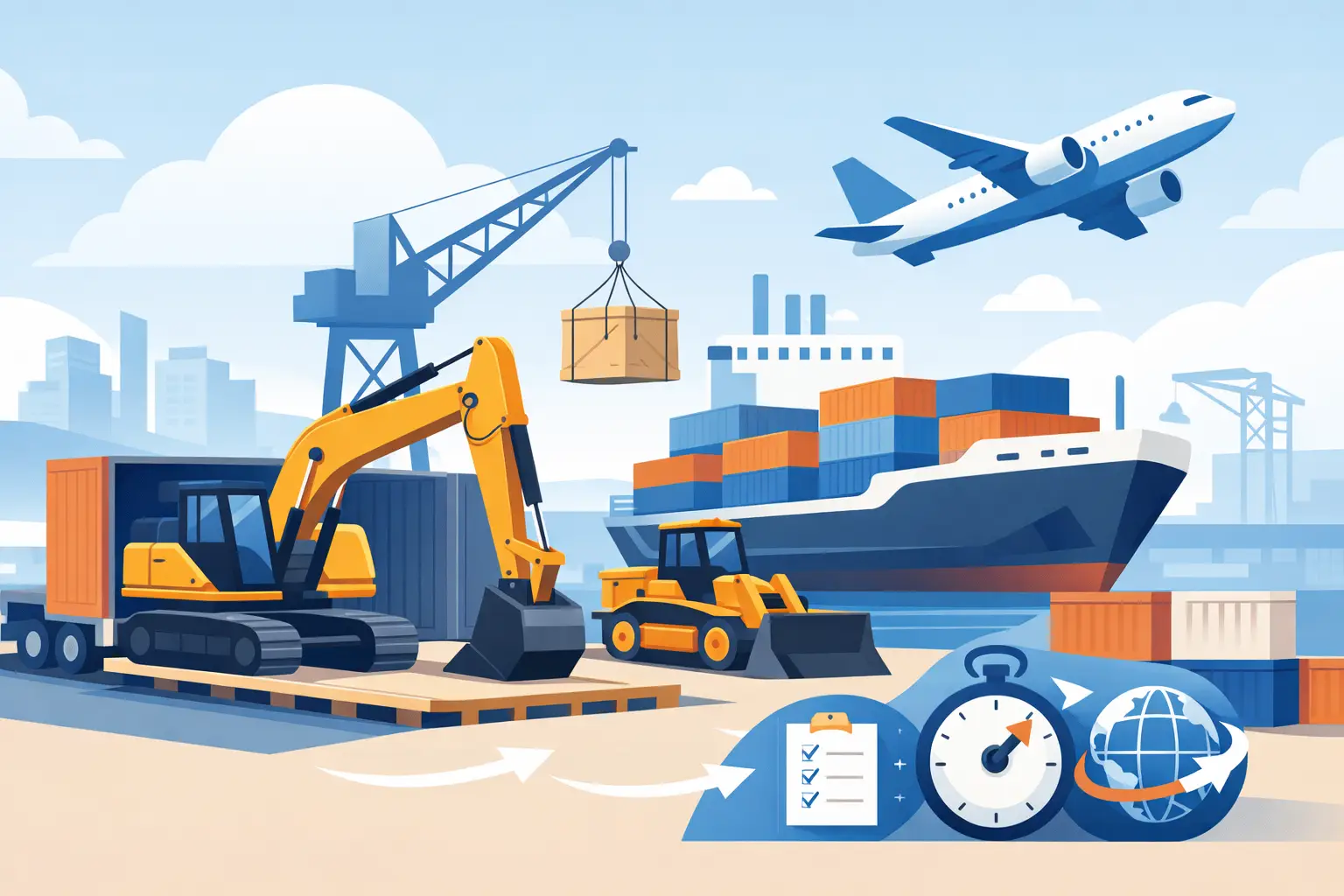
A delayed excavator, an uncertified generator, or a loader shipped with the wrong paperwork can hold up an entire job, not just a single delivery. That is why heavy machinery export is not simply about getting equipment onto a vessel. For professional buyers, it is about securing the right unit, in the right condition, with the right documentation, packed correctly, and moved fast enough to protect operational schedules.
In real terms, export success is usually decided before the machine leaves the yard. Stock status, inspection standards, emissions and serial verification, crating or container planning, and destination requirements all matter. If one part of that chain is weak, the cost shows up later through port delays, site downtime, installation issues, or rejected customs clearance.
What buyers actually need from heavy machinery export
Commercial buyers rarely need a sales pitch. They need confidence. A contractor replacing a failed machine, a plant operator sourcing backup power, or a reseller building stock for regional demand is usually working against time, budget, and service commitments. The question is not whether a machine can be exported. The question is whether it can be exported properly.
That means equipment should be clearly identified, tested where relevant, and supplied in a condition that matches the stated specification. It also means the export process should be managed by people who understand more than freight booking. Machinery buyers need practical support around brand, model, output, fitment, accessories, and transport method. A cheap unit becomes expensive very quickly if it arrives incomplete or unsuitable for the intended application.
For many businesses, complete units are the safer route. Ready-to-install equipment reduces workshop time, lowers compatibility risk, and gives procurement teams a more predictable path from purchase to commissioning. That matters whether the order is for generators, industrial engines, marine propulsion packages, or heavy-duty machinery destined for commercial use.
The difference between a simple shipment and a reliable export supply chain
A serious heavy machinery export operation works as a supply chain, not a forwarding exercise. There is a practical difference. Forwarding alone focuses on movement. A supply-led export process focuses on movement, compliance, condition, and handover quality.
For buyers in GB and overseas markets, this starts with accurate stock information. If a supplier is vague on availability, lead times often drift. If they are vague on machine condition, buyers end up making assumptions. Neither helps when the equipment is needed for a vessel repower, a site replacement, or a fleet maintenance schedule.
The stronger approach is straightforward. Confirm the unit, confirm the specification, confirm the test status, confirm the paperwork, then ship. That sounds obvious, but many export problems come from skipping one of those steps in order to move faster. Speed matters, but unstructured speed creates expensive delays later.
Documentation is where many export problems begin
The equipment itself is only one part of the transaction. Documentation often decides whether cargo clears smoothly or sits at the port while charges accumulate. Commercial invoices, packing lists, serial records, certificates where applicable, and destination-specific import paperwork need to align with the actual machine being shipped.
This is especially important with recognised brands and regulated equipment categories. Buyers want proof of what they are purchasing, not broad descriptions. Engine numbers, model references, power ratings, and packaging details should be consistent across the file. If the paperwork says one thing and the physical cargo says another, the buyer is left resolving a problem they did not create.
There is also a commercial point here. Clear export documentation helps procurement teams account for assets properly, supports insurance, and reduces friction with internal compliance checks. For resellers and fleet operators, that administrative certainty is almost as important as the machinery itself.
Packing, handling and routing are not minor details
Heavy equipment does not fail in transit because of bad luck alone. It often fails because packing and handling were treated as an afterthought. Exposure, shifting loads, poor securing, fluid issues, and inadequate lifting preparation can all turn a good machine into a claims problem.
The right export method depends on the unit. Some machinery is best moved in containers, particularly where protection and dimensional control are priorities. Other units are better suited to flat rack or roll-on/roll-off transport, especially when size and handling characteristics make containerisation impractical. There is no single best option. The right one depends on dimensions, destination, urgency, and the condition in which the buyer needs the equipment to arrive.
A supplier who understands machinery export should be able to advise on that without guesswork. They should also think ahead about unloading conditions at destination. There is little value in shipping efficiently from origin if the receiving side is not prepared for the actual package size, weight, or lifting requirements.
Why tested and certified equipment matters more in export
When buying locally, a problem can sometimes be handled with a short return route or an immediate site visit. Export changes that equation. Distance increases the cost of every mistake. That is why tested, certified, and properly described equipment carries more value in international trade than it does in casual domestic sales.
For professional buyers, the issue is not just trust. It is risk allocation. If a machine is sold as operational, buyers expect supporting evidence. If it is sold as export-ready, they expect the condition and paperwork to support that claim. If it is a complete unit, they expect fewer unknowns during installation.
That is one reason complete engines, generator sets, propulsion systems, and heavy-duty machinery remain in strong demand for export markets. Buyers are trying to reduce downtime, labour hours, and commissioning uncertainty. In sectors where asset utilisation matters, that is a commercial decision, not a convenience.
Choosing the right supplier for heavy machinery export
The strongest suppliers do more than quote a shipping cost. They understand applications, they know the major brands, and they can support both one-off procurement and repeat trade orders. That matters if you are sourcing for mixed sectors such as marine, industrial power, automotive, or construction support.
A useful test is how a supplier handles detail. Can they speak clearly about complete units versus loose components? Can they support bulk or custom sourcing? Can they confirm testing status and export packing options without chasing basic information? If not, the transaction may become reactive at exactly the point where you need control.
This is where a specialist exporter has an advantage over a general trader. Businesses such as World Engine Traders operate around ready-to-ship equipment, recognised brands, and account-supported export supply. That model suits buyers who need certainty on stock, technical credibility, and post-sale support rather than open-ended sourcing promises.
Cost matters, but so does landed reliability
Price always matters in procurement, but headline price is only one part of the buying decision. A lower-cost machine can become the higher-cost option if it needs rectification, arrives late, or creates avoidable customs and installation issues. Professional buyers tend to look at landed reliability rather than invoice value alone.
That includes freight mode, packing quality, port handling, inland transport, compliance risk, and the likelihood of immediate commissioning. It also includes supplier responsiveness. When schedules are tight, slow communication can be as damaging as a technical fault.
There are cases where buying lower-spec or non-immediate stock makes sense, particularly for planned refurbishment or resale channels. But for replacement programmes, outage cover, and mission-critical use, buyers usually benefit from tested units with clear export handling and a defined support path.
A practical standard for export-ready machinery
Export-ready should mean more than available for collection. In practical terms, buyers should expect a machine or equipment package that is correctly identified, professionally handled, and commercially documented for cross-border movement. They should also expect realistic advice on transit method, timings, and any destination-specific limitations.
That standard is not excessive. It is the baseline for dependable trade. In heavy machinery export, the transaction is only successful when the equipment arrives as expected and can move into service without unnecessary delay.
For serious buyers, that is the measure that counts. If your next order supports revenue, contracts, or fleet continuity, choose supply that is built around tested units, clear paperwork, and export discipline from the start. The cheapest route is rarely the one that gets the machine working fastest.
