
When a vessel is down, the cost is rarely limited to the engine itself. Lost charter days, delayed deliveries, idle crews and missed service windows add up quickly. That is why choosing the right outboard motor export supplier is not a routine purchasing task for professional buyers. It is a risk decision with direct operational consequences.
For marine businesses, distributors, fleet operators and workshop buyers, the real question is not simply who can quote fastest. It is who can supply the correct outboard, from a recognised brand, in export-ready condition, with the paperwork, handling and technical support needed to get it delivered and installed without unnecessary delay. Price matters, but so do specification accuracy, stock integrity and after-sales response.
What a serious outboard motor export supplier should provide
A genuine trade supplier does more than move boxes between ports. In the outboard market, the difference between a smooth transaction and a costly mistake often comes down to preparation before shipment. Complete unit supply, model verification, testing status and export documentation all need to be handled properly.
Professional buyers should expect access to complete outboard motor units rather than incomplete assemblies, unknown-condition used stock or rebuild-focused packages unless those have been specifically requested. A ready-to-install engine reduces workshop hours, simplifies procurement approval and lowers the risk of discovering missing components after delivery. For commercial operators, that matters more than a marginal saving on headline price.
Brand credibility also carries weight. Outboards from manufacturers such as Yamaha, Mercury and Honda remain in demand because buyers know the support networks, parts availability and performance history. An export supplier dealing in recognised brands gives procurement teams stronger technical confidence and a clearer service path once the equipment reaches its destination.
Why export capability matters as much as product availability
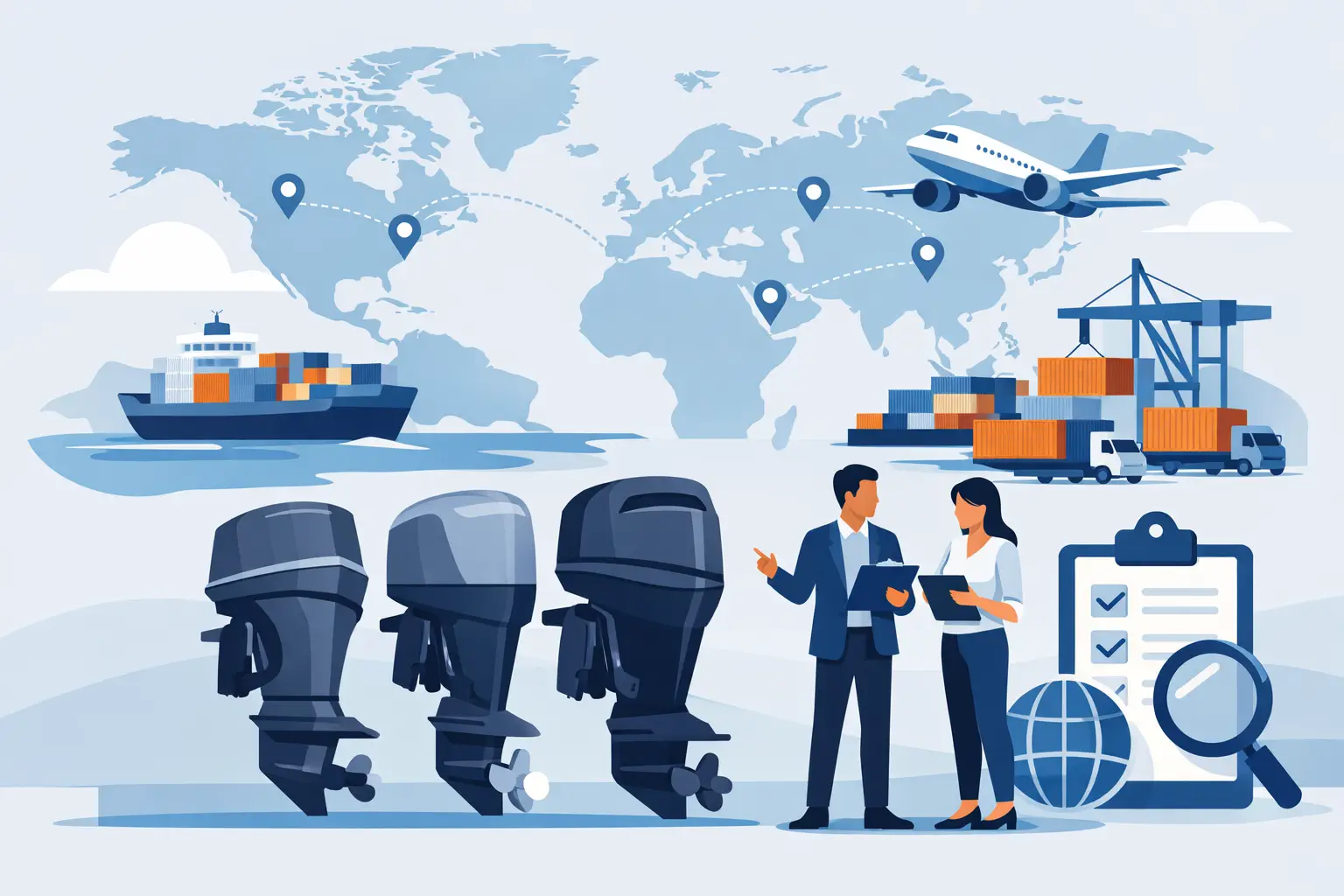
Not every stockist is equipped to handle international engine supply. Exporting outboards properly involves more than arranging freight. There are packing standards, customs requirements, commercial invoices, serial number traceability and destination-specific considerations that need to be correct from the outset.
This is where many transactions become inefficient. A seller may have the engine, but not the export process behind it. That leads to paperwork delays, avoidable port storage costs or shipment holds that put the buyer under pressure. For commercial procurement, those are not minor administrative issues. They affect deployment dates, client commitments and cash flow.
An experienced outboard motor export supplier should be able to confirm whether the engine is in stock, tested where applicable, prepared for shipment and supported with the required export documentation. The best suppliers are direct and precise. They should be able to state what is available, what lead time applies, what is included, and what the delivery route realistically looks like.
Stock claims versus actual supply
One of the most common problems in international equipment sourcing is the gap between advertised availability and real stock control. In the marine sector, that gap can waste days or weeks. A buyer sends an enquiry for a specific horsepower, shaft length or control configuration, receives a quick price, then discovers the unit is not physically available or does not match the required build.
That is why stock quality matters as much as stock quantity. A credible supplier should be able to confirm exact model references, year or series where relevant, and whether the engine is supplied as a complete package with controls, rigging elements or only the base unit. This is especially important for repower projects, where compatibility with existing transoms, helm controls and electrical systems may affect the installation plan.
For trade buyers, clear specification matching saves more money than aggressive discounting. A cheap unit that requires additional adaptation, delayed parts sourcing or workshop improvisation is rarely cheap by the time it is operational.
Tested, certified and ready for work
Marine buyers have little use for vague assurances. Terms such as tested, inspected and export-ready need to mean something measurable. The more commercially critical the application, the more important it becomes to establish the condition and supply standard before payment and dispatch.
In practice, buyers should look for evidence that the outboard unit has been checked to a recognised standard and that the engine identity is properly recorded. Certification expectations can vary by destination and use case, so there is no single rule for every market. Even so, a supplier should be able to explain the status of the unit clearly, without ambiguity or sales padding.
There is also a practical distinction between complete engine units and parts-led supply. For many professional buyers, complete units are the lower-risk route because they shorten time to installation and reduce uncertainty across multiple component lines. That approach aligns with how serious operators manage downtime – by replacing quickly with known equipment, not by assembling a solution from several unverified sources.
How to assess an outboard motor export supplier before ordering
A supplier should be judged on how they handle detail. Early communication usually reveals whether you are dealing with a serious export operation or a broker with limited control over the product. If the responses are slow, vague or inconsistent at quotation stage, the transaction is unlikely to improve once funds have been transferred.
Ask direct questions and look for direct answers. Can they confirm exact stock? Can they identify included components? Can they provide engine details and export documentation requirements? Can they support bulk or repeat orders if this becomes an ongoing supply relationship? Buyers managing fleets or resale channels need consistency, not one-off opportunism.
It also helps to judge the supplier by the range of related support they can offer. A business handling engines, propulsion systems, generators and drivetrain equipment is often better positioned to support technical questions and broader procurement needs than a seller focused only on isolated transactions. Where a supplier understands commercial equipment rather than just retail sales, communication tends to be faster and more relevant.
Trade-offs buyers should weigh carefully
There is no single right purchasing route for every outboard order. The best choice depends on urgency, budget, destination and operating duty. A brand-new unit may offer the clearest compliance and service path, but tested used or surplus stock can make commercial sense where lead time is critical or the vessel is working in a cost-sensitive application.
Bulk purchasing may improve unit economics, though it can also increase warehousing pressure and tie up capital if deployment schedules change. Buying from the nearest source may reduce transport complexity, but not if that supplier cannot provide the documentation or model accuracy required for export. Likewise, the lowest quote may be valid only if the buyer is prepared to absorb greater technical and logistical risk.
This is where experienced procurement teams separate purchase price from ownership cost. The right engine at the wrong time, or with the wrong paperwork, is still the wrong purchase.
What professional buyers value after delivery
The export transaction does not end at the port. Once the outboard arrives, the buyer may still need installation support, parts access, serial verification or commercial follow-up. Suppliers who remain responsive after shipment are easier to work with over the long term, particularly for service businesses, resellers and operators managing multiple assets.
That is why many buyers prefer suppliers built around complete equipment and ongoing account support rather than one-off listings. A dependable supply partner makes future ordering easier because they already understand your preferred brands, operating environment and documentation expectations. For businesses sourcing repeatedly across marine and industrial categories, that continuity has real value.
Companies such as World Engine Traders operate in that space because professional buyers do not just need engines. They need tested, recognised equipment with export handling that stands up to commercial timelines.
The supplier decision that affects everything downstream
An outboard purchase can look straightforward on paper: brand, horsepower, shaft length, destination. In reality, the supplier behind the order determines whether those specifications become a working asset on schedule or a procurement problem that drags through freight, customs and workshop delays.
The strongest outboard motor export supplier is not the one making the loudest claims. It is the one that can verify stock, supply complete units, support recognised brands, handle export documentation properly and respond like a trade partner who understands what downtime costs. When that standard is met, buying becomes faster, cleaner and far more predictable.
