
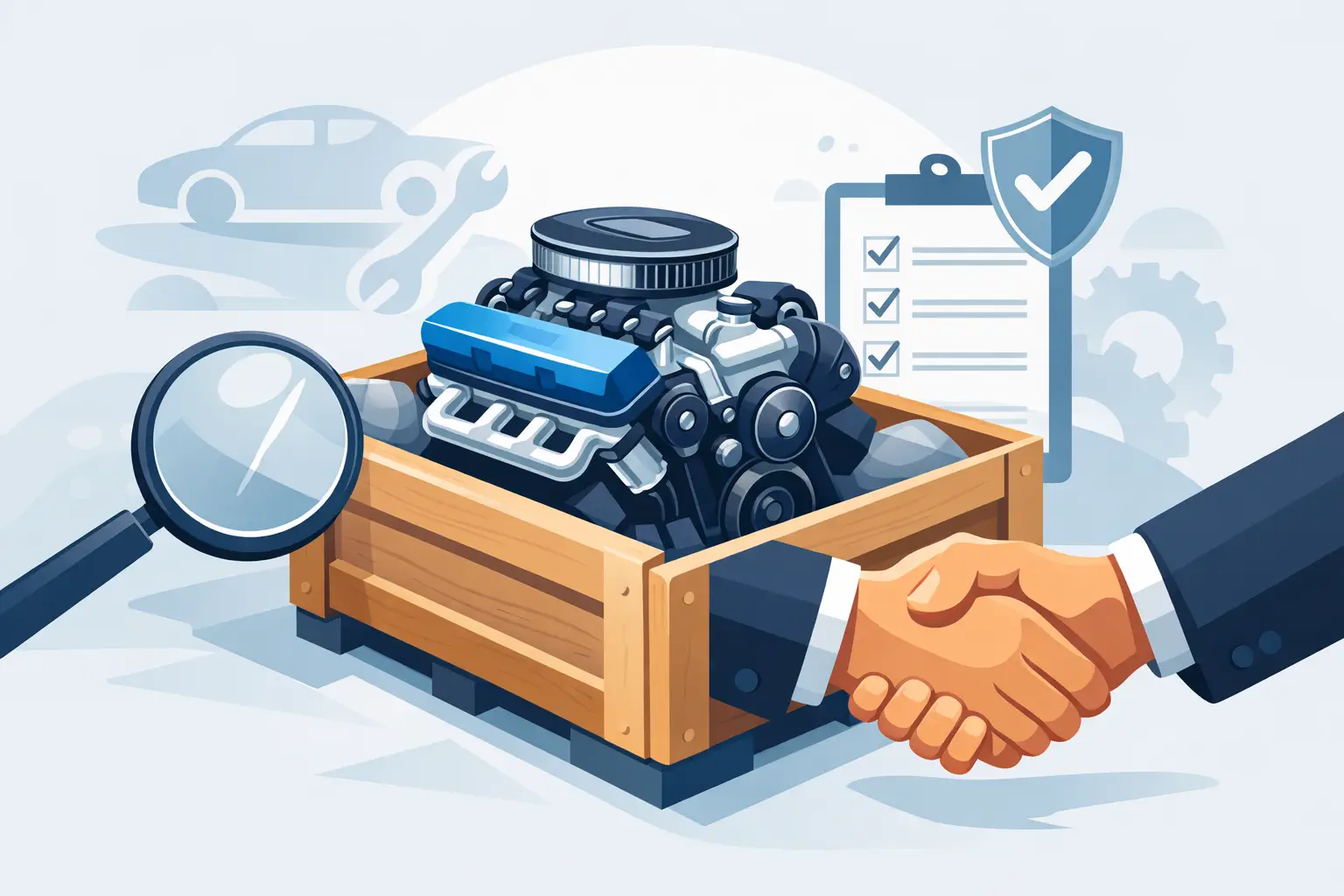
A failed engine rarely arrives at a convenient moment. It stops a workboat earning, keeps a vehicle off the road, delays a customer handover or leaves a generator-dependent site exposed. When you need to buy complete crate engine stock, the real question is not only price – it is how quickly you can get a tested, correctly specified unit into service without creating new problems downstream.
For professional buyers, that changes the way the decision should be made. A complete crate engine is not just a boxed long block. In commercial purchasing, it is often the fastest route back to operation because the unit is supplied as a ready-to-install package rather than a collection of uncertain parts, missing ancillaries or rebuild components that still need workshop time. That distinction matters when downtime has a direct cost.
Why buyers choose a complete crate engine
There is a practical reason more workshops, fleet operators and marine businesses choose complete engine assemblies over piecemeal rebuilds. Predictability. A complete unit reduces the number of variables at installation stage, especially where labour hours, scheduling and parts compatibility are tightly managed.
A rebuild can still be the right route in some cases, particularly when an existing engine has a rare specification, matching numbers matter, or the asset has low annual usage and ample workshop time available. But for most working applications, rebuild projects tend to expand. Once the engine is open, wear in the head, fuel system, cooling circuit or rotating assembly often pushes the job beyond the original estimate.
A properly supplied crate engine gives buyers a clearer commercial position. You know the engine type, output, major installed components and supply condition before it reaches site. That helps engineering teams plan the swap and helps procurement teams control the total landed cost.
What to check before you buy complete crate engine units
The biggest purchasing mistakes happen before the order is placed. Not because the engine is poor quality, but because the supplied unit does not match the application in the detail that matters.
Start with the exact engine code, serial reference and intended application. Two engines may appear identical by family or displacement, yet differ in emissions configuration, sump design, accessory mounting, flywheel housing, ECU calibration or cooling arrangement. In marine work, this becomes even more critical because wet exhaust layouts, heat exchanger arrangements and transmission compatibility can change installation requirements significantly.
The next point is supply condition. Ask whether the engine is delivered as a complete drop-in unit, and define what “complete” includes. On serious trade purchases, that should not be left vague. Clarify whether the package includes fuel system components, manifolds, injectors, turbocharger where applicable, starter motor, alternator, wiring loom, ECU, sensors and mounting hardware. A crate engine that is cheaper on paper can become slower and more expensive if key items have to be sourced separately.
Testing and certification also deserve close attention. A professional buyer should expect evidence that the engine has been inspected and tested according to its type and condition. That does not always mean the same procedure across every engine category. A small petrol automotive unit, an industrial diesel and a marine propulsion engine each have different technical priorities. What matters is that the seller can state clearly what has been checked, what standard the unit meets and what documentation is available.
Specification first, price second
Price always matters, but experienced buyers know headline cost can hide the real exposure. The wrong engine, a partial engine, or an engine with weak documentation can consume any upfront saving very quickly.
When comparing quotes, look at the full package rather than the unit figure alone. Include transport, export packing, taxes or duties where relevant, lead time, included components, warranty terms and the likely installation hours. If one supplier offers a lower price but cannot confirm stock status, test records or complete assembly content, that quote is not directly comparable.
This is especially relevant for resellers and contractors quoting onward to their own customers. If your margin depends on accurate delivery and predictable fitting time, certainty has a commercial value. Paying slightly more for a verified, ready-to-install engine often protects the job better than chasing the lowest available number.
Buy complete crate engine supply for commercial uptime
In commercial environments, the engine is only part of the decision. Uptime is the actual product being purchased. Whether the engine is going into a pickup, patrol vessel, generator set, plant machine or workshop customer vehicle, the buying process should be built around return-to-service speed.
That means asking sensible operational questions. Is the unit physically in stock or subject to sourcing? Is it prepared for immediate dispatch? Can the seller support international shipping and export paperwork if the engine is moving outside the UK? If there is a serial-number check or application review needed, how quickly can that be handled?
A supplier focused on complete engine units should be able to support this process without excessive back-and-forth. Professional buyers do not need sales language. They need clarity on availability, condition, compatibility and dispatch.
The role of recognised brands and proven platforms
Brand matters in engine procurement, but not for image reasons. It matters because known platforms bring predictable parts support, service familiarity and installation confidence. Buyers in marine, automotive and industrial sectors often specify brands such as Yanmar, Perkins, Honda, Yamaha, Mercury or CAT because technicians already understand their architecture and support chains.
That familiarity reduces risk. It can shorten diagnostic time, simplify parts stocking and improve resale confidence on the finished machine or vessel. It also helps when engines are being shipped internationally, where local service capability may depend heavily on brand presence.
There is still a trade-off. Premium brands can carry a higher acquisition cost, and in some lower-duty applications that may not produce a proportional return. But in high-usage, revenue-producing equipment, the stronger support ecosystem is often worth the difference.
Logistics are part of the engine purchase
Too many buyers treat shipping as an afterthought. With crate engines, logistics should be evaluated as part of the product itself. An engine that is technically correct but poorly packed, delayed in documentation or mishandled in export transit creates the same operational problem as an incorrect unit.
For international orders, export readiness is not optional. The supplier should understand secure crating, customs documentation, freight coordination and the practical realities of moving heavy equipment across borders. This matters just as much for a single replacement engine as it does for bulk supply.
If you are buying for stock, not immediate installation, ask about storage condition and preservation. An engine that will sit in a warehouse before fitment may need different preparation from one going straight to workshop installation. Again, detail matters.
Who should avoid a crate engine?
A complete crate engine is not automatically the right answer for every job. If the existing engine has minor, isolated damage and the rest of the system is in strong condition, a targeted repair may deliver better value. The same applies where installation constraints make a complete replacement more complex than an in-situ overhaul.
There are also applications where reuse of accessories or external systems is expected, so a “complete” unit may include components you do not need. In those cases, the best buying decision depends on labour cost, asset age, service life expectations and how critical the equipment is to operations.
The key is not to assume. Match the engine supply route to the commercial objective. If speed, reliability and lower installation uncertainty are the priority, a complete crate engine usually makes the strongest case.
Choosing a supplier, not just an engine
The supplier’s model tells you a lot about the buying experience. A serious trade supplier should understand serial verification, application matching, bulk orders, export handling and post-sale technical support. That is very different from buying from a general marketplace seller moving mixed stock without technical accountability.
For procurement teams and workshop owners, support after the invoice matters because installation questions often appear only when the unit is on site. The right supplier can help resolve specification checks, supply documentation and practical fitment concerns before they affect the job timeline. That is one reason buyers working across marine, industrial and automotive categories often prefer specialist exporters and equipment suppliers such as World Engine Traders.
When you are ready to buy complete crate engine units, the strongest position is simple: verify the specification, confirm what is included, understand the testing standard, and make sure logistics are handled with the same care as the engine itself. A good purchase is not the one that looks cheapest on day one – it is the one that gets the equipment back to work without avoidable delay.
